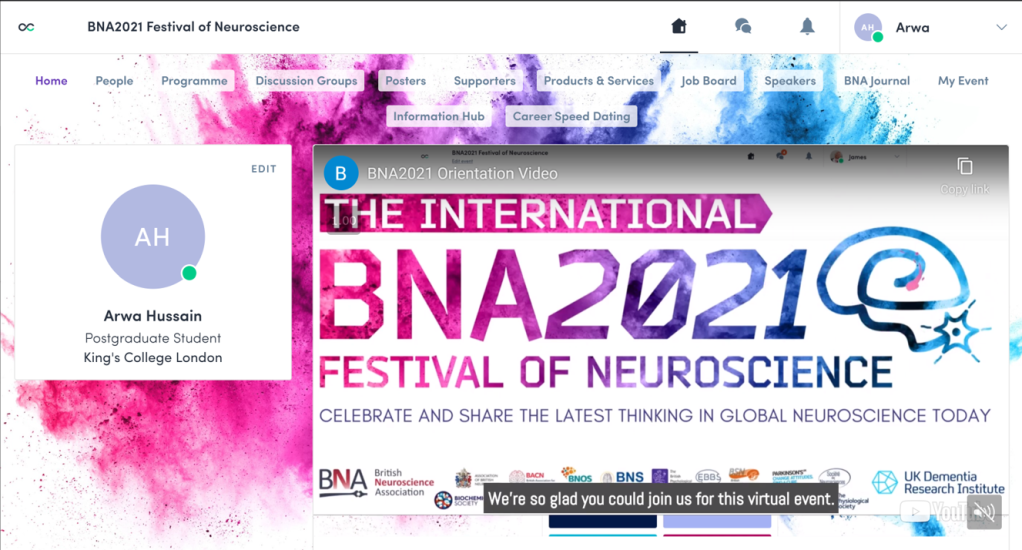
I had the opportunity to attend The International Festival of Neuroscience 2021. This virtual event, spanning 4 days, was jointly organised by the British Neuroscience Association and the UK Dementia Research Institute. This was primarily an academic conference that showcased cutting-edge neuroscience research via plenary lectures and poster presentations.
My review will cover 4 aspects:
- Usability of Platform
- Programme Structure and Topics
- Networking Opoortunities
- Pricing.
1. Platform
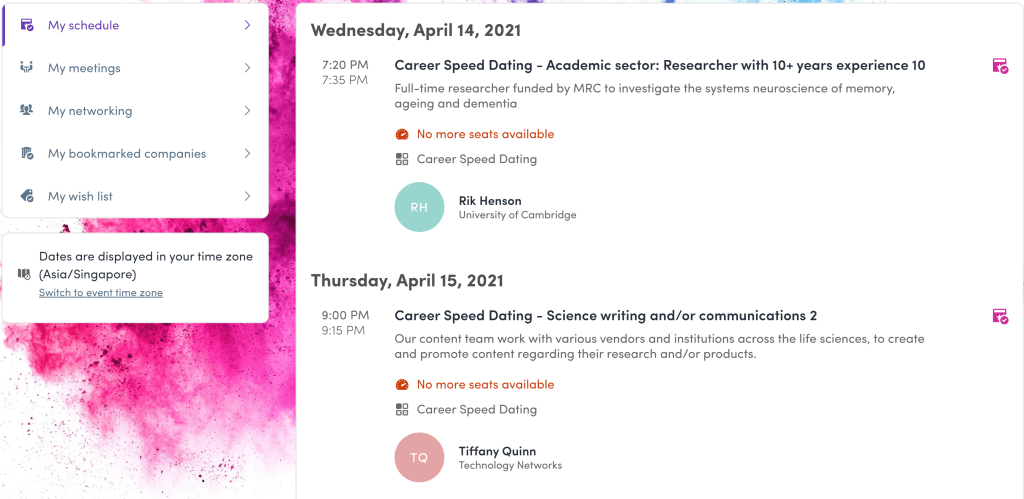
Let’s start with the platform. As mentioned, this was a virtual event; thus, the entire festival was hosted on a website. I was pleased to discover that the site was user-friendly and easy to navigate. There was a built-in schedule-maker where you could register for talks, and a personalised daily schedule would automatically appear in the sidebar. Another feature I found helpful was the filter function wherein I could search for specific categories or speakers without loading page after page of results. I appreciated the detailed guide on how to navigate the website but barely glanced at it. All in all, a pleasant experience.
2. Programme
I was blown away by the sheer diversity of topics that the event covered, ranging from stem cells and computational neuroscience to cognition and mental health. In addition to topic variety, there were many different kinds of talks such as:
- Plenary Lectures
- Poster presentations
- Career “speed-dating” events where a clinician, researcher or industry leader would have a casual chat about their area of work
- Workshops to learn about various software and tools
It was for this very reason that the 4-day time frame of the event felt very rushed. Although there are 4 months of on-demand videos, it would be nice to watch a session live, ask questions, and be answered immediately. Twice a day, there were 7 parallel streams, and to choose just one…well, it really highlighted the woes of the paradox of choice to me! I understand that “standard” conferences are usually this long, but nothing about life in this pandemic is “standard”. A longer timeframe, perhaps a week or so, would have been ideal.
3. NETWORKING
The main gripe we usually have in this zoom-era is that we miss out on the human touch and connecting with others. For PhD students and early-career researchers, these academic conferences are a way for their work to be “seen” (outside of publishing) and for them to network with like-minded folk. I’m neither a PhD student nor a researcher, but I found that connecting with people on this platform felt easier (compared to real-life).
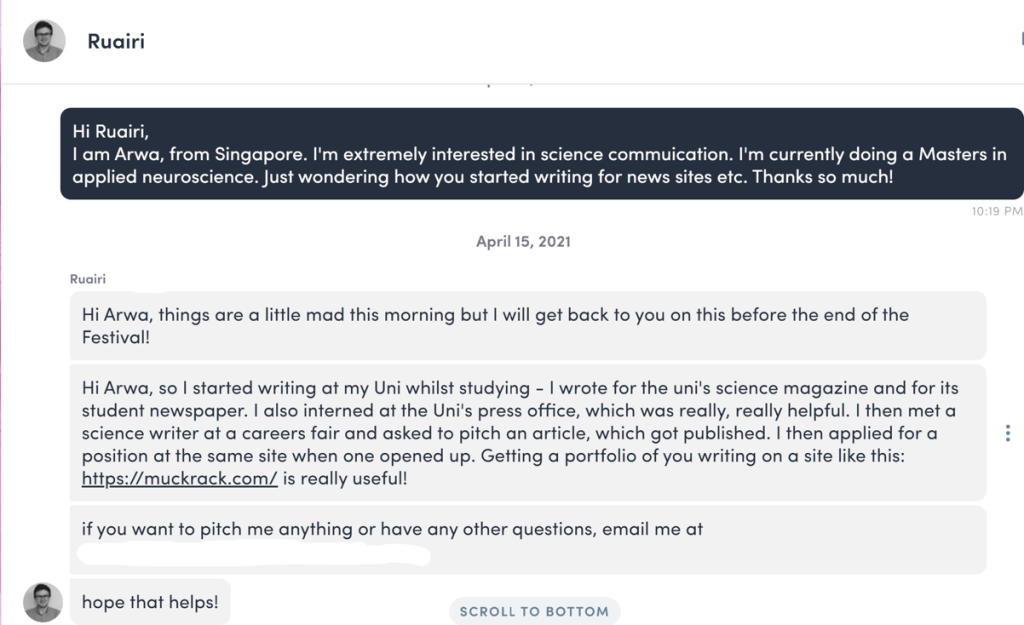
Now, I’m by no means a shy person but the prospect of going up to a speaker (usually with decades of experience in the field) after a live presentation, making small talk and asking for their email/ contact details is pretty daunting. The whole process, mainly thanks to the platform, was so much easier online. Firstly, you could set up your profile with a picture and a short biography and request to connect with someone. Of course, you still had to put yourself out there and ask questions, but the virtual space gave me the assurance that we were “on equal footing”. I connected with a few people and am looking forward to connecting more in the coming months.
4. Pricing
If you’re still considering whether this festival is worth the price tag of approximately $130 SGD (this is what I paid but the cost varies depending on whether you’re studying and your membership in the British Neuroscience Association), here are some factors to consider.
- Are you only interested in learning about the brain? If so, you can give this a miss because, honestly, Youtube is free! There are thousands of talks on neuroscience already. Go explore that first!
- Are you keen on connecting with others? If so, this event is one of a kind. A forum where you discuss your research or career interests with “reliable people is hard to find. Sure, Reddit is veritably swarming with self-professed experts. Over here, however, you can be assured that the people who give talks have been – to borrow a social media terminology – verified. Hence, you know that you’re getting advice from the “real-deals”.
- Will this positively impact your career? Academic conferences are an avenue to present your research. If you’re not doing that, it might not be a worthy investment especially if you’re on a tight budget.
Click here to register for the BNA 2021 and let me know how you liked it!
 Arwa Writes