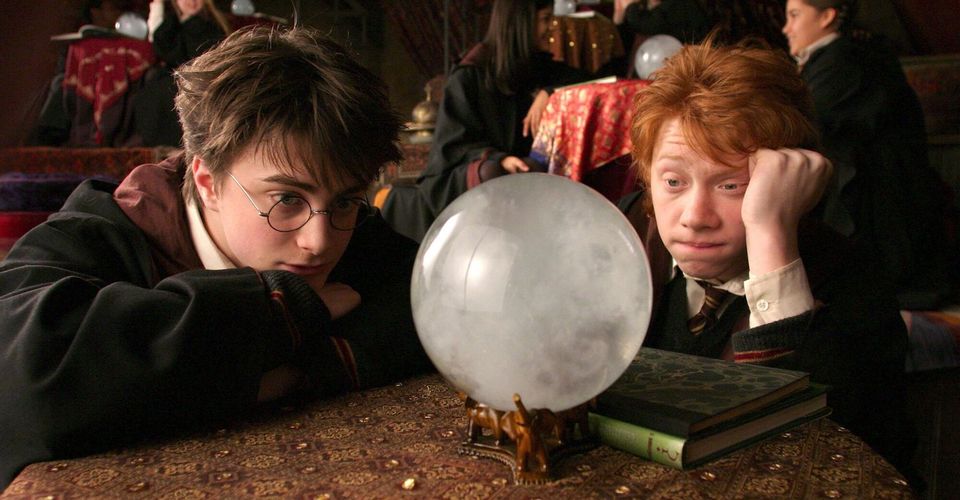
If there’s one thing I feel a smidgen of smugness towards, it is this: I have a rich and detailed night-dream life. What I mean is, I dream a lot: bizarre dreams, grand dreams, sad dreams, you know, the lot. I used to keep a dream journal when I was 10. In the mornings, as I clung to the last vestiges of sleep, I scribbled down the events that had played out in my dreamscape. I admit I was inspired by Trelawney’s Divination homework (and much like Harry and Ron, I stopped because I got lazy).
I suppose you’re wondering how I’ve acquired this smug sense of superiority over something as banal as a dream. The fact is, we all dream. Throughout a lifetime, the average person spends 50,000 hours or 2000 days or 6 years dreaming. People believe they don’t dream, but we spend roughly 2 hours a night dreaming though we forget most of it, unlike James Watson. See, the double helix structure of the DNA came to James Watson in a dream. It’s true! I listened to the TEDTalk, mouth agape; the guy got a Nobel Prize for dreaming of . . . a spiral staircase?! I shudder to think how Freud would’ve psychoanalysed the latent meaning of that dream.
The list of people who have won Nobel Prizes for dreaming doesn’t end there. Niels Bohr, who discovered the structure of the atom, dreamt that electrons spin around the nucleus the way planets orbit the sun (albeit at a much faster rate).

Mary Shelley, the author of Frankenstein, had a vivid nightmare that inspired her writing.
I saw the pale student of unhallowed arts kneeling beside the thing he had put together. I saw the hideous phantasm of a man stretched out, and then, on the working of some powerful engine, show signs of life, and stir with an uneasy, half-vital motion.
Mary Shelley

She didn’t win a Nobel Prize, but we can all safely conclude that dreams correlate with genius. I knew I was right to be smug.
Now we’ve established that dreaming is ‘good’ (at least in terms of winning Nobel Prizes), but you’re probably wondering about the difference between dreaming at night and daydreaming. Don’t both involve fantasising about imagined scenarios? Well, yes but the differentiating factor is (quite obviously) sleep: something you can’t live without.
You might not be aware of this but there are four distinct stages of sleep.
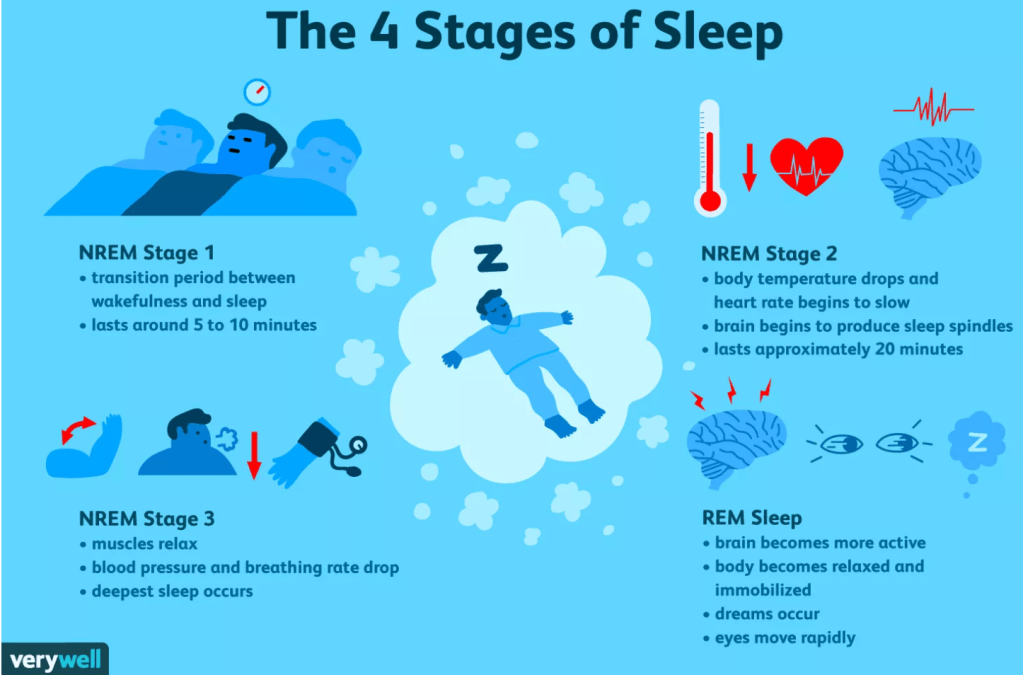
Dreaming occurs in the Rapid Eye Movement (REM) phase of sleep. Brain activity during REM sleep resembles the irregular, faster pattern of waking life, suggesting that, although the body is not moving, the brain is quite active. The function of REM sleep is not clear, but if a person is repeatedly awakened from it, the brain will return to it with increasing persistence! We spend about 25% of all sleep time in REM sleep. In a nutshell, we need REM sleep, and its’ result: dreaming.
A cognitive view of dreaming suggests that dreams are “cognitive constructions that reflect the concerns and metaphors people express in their waking thought”. Simply put, dreams are a form of thought. It has been postulated that dreams may serve a problem-solving function, presenting the dreamer with potential solutions to daytime problems. By that logic, could dream activity be ‘productive’ even if the person is not consciously trying to solve the problem at night? This is likely the case for James Watson and Niels Bohr. I’m sure you recall instances where you’ve been stuck at a problem at night, only to discover that morning brought with it a solution you had been chasing. All this talk of ‘productivity’ and ‘problems’ might lead you to assume that dreams are just another avenue to get work done. As though even our dreams are mocking us for being lazy, incompetent procrastinators during our waking hours. I now present you with two lines of argument that suggest that dreams – at their core – are fun and freeing.

Let’s start with the former – fun. It’s tempting to roll your eyes at Trelawney’s Divination-related theatrics, but dream interpretation is versatile: it can be a quiet, reflective activity or a fun party anecdote. Since time immemorial, many cultures have ascribed symbolic meanings to dreams. They can be prophetic divinations, which allude to future events or represent unconscious wishes or fears like Freud theorised. Dreams can be interpreted in whichever way you like, making interpretation a creative outlet and a key to understanding yourself.
Finally, I argue that dreams are freeing. A common gripe about dreaming is that we don’t have control over them, and to that, I say, “so what?” Most of our waking moments are spent making one choice after another, from trivial everyday should-I-or-should-I-nots to big life decisions. Dreaming is where you yield to the might of your unconscious, where you’re an actor in a bizarre plot you can’t hope to grasp, where anything can happen, and you let it (even if you don’t win a Nobel Prize).
 Arwa Writes